

Expedited U.S. citizenship for spouses of citizens working abroad.
Section 319(b) lets the permanent-resident spouse of a U.S. citizen working abroad naturalize on an expedited timeline. It waives the standard continuous-residence and physical-presence requirements.
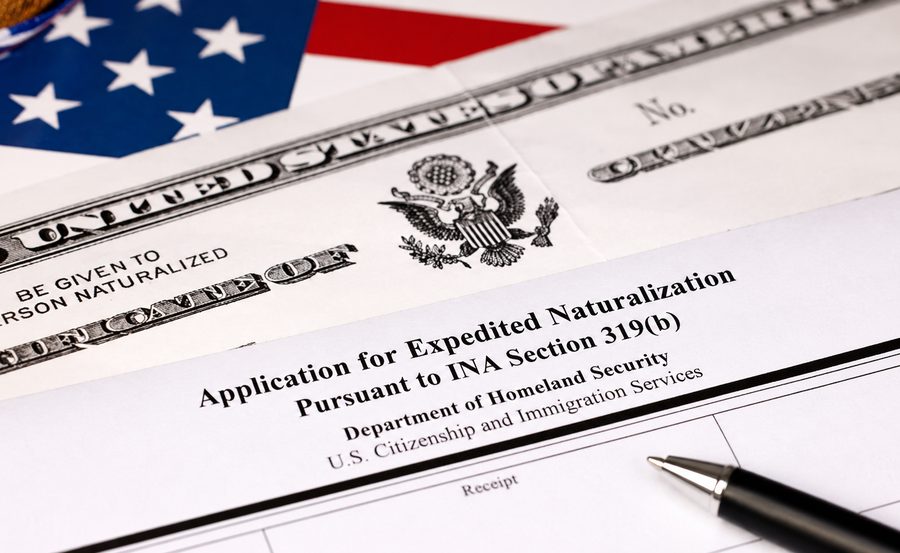
- Who it's for. The lawful permanent resident spouse of a U.S. citizen in qualifying employment abroad.
- The benefit. No standard continuous-residence or physical-presence requirement — citizenship on a faster timeline.
- Qualifying employment. Six statutory categories — U.S. government, research institution, U.S. firm, public international organization, clergy, or missionary work.
- The filing. Form N-400 on the §319(b) basis, supported by the all-important employer evidence.
- Document-sensitive. Early legal screening prevents wasted filing fees and a problematic naturalization record.
Why 319(b) matters
INA 319(b) solves a concrete problem. A green-card holder married to a U.S. citizen assigned abroad would normally have to maintain continuous residence and physical presence in the United States before naturalizing. That is hard or impossible while living overseas with a spouse. Section 319(b) removes the barrier for qualifying families.
The advantages are concrete:
- Faster U.S. citizenship — without waiting out the ordinary residency period.
- Reduced re-entry anxiety — no need to track and preserve U.S. residence the way a standard N-400 applicant must.
- Easier international mobility — citizenship resolves the practical strain of building a life abroad while holding only a green card.
- No need to preserve U.S. residence in the same way as a standard naturalization case.
Who qualifies
To naturalize under INA 319(b), you must establish each of the following:
- You are a lawful permanent resident. You hold a green card. Not yet an LPR? We can help with that step too.
- You are married to a U.S. citizen.
- Your U.S. citizen spouse is regularly stationed abroad for at least one year in qualifying employment.
- You intend to reside abroad with your spouse and to return to the United States when the qualifying employment ends.
Qualifying employment
The statute recognizes six categories of qualifying overseas employment. What matters legally is the category, not the specific employer:
- U.S. government. Civilian and uniformed service postings abroad.
- A U.S. research institution recognized by the Attorney General.
- A U.S. firm or corporation (or its subsidiary) engaged in the development of the foreign trade and commerce of the United States.
- A public international organization of which the United States is a member by treaty or statute.
- Clergy of a religious denomination that has a bona fide organization in the United States — someone authorized to perform its ministerial or priestly functions.
- A missionary engaged solely as such by a religious denomination, or by an interdenominational mission organization, with a bona fide U.S. organization.
Common situations we see include U.S. government, military-adjacent, American company, nonprofit, missionary, research, international-organization, and overseas corporate assignments.
The 319(b) process
- File Form N-400 with the §319(b) basis selected and documented.
- Submit employment evidence — the offer letter, documentation of the assignment abroad, and proof that the citizen spouse is "regularly stationed abroad."
- Biometrics in the United States.
- Interview with USCIS in the United States, including the English and civics tests.
- Oath of Allegiance in the United States.
- Return abroad — generally within about 30 to 45 days of the oath, consistent with the intent to reside abroad with the spouse.
Common pitfalls
319(b) is a niche, document-sensitive category. The issues that most often derail a case:
- The U.S. citizen spouse's employer may not actually qualify under the statute.
- "Regularly stationed abroad" is under-documented.
- The assignment may not clearly last at least one year.
- The couple lacks evidence of intent to live abroad together.
- USCIS scrutinizes the applicant's intent. It weighs both the intent to return to the U.S. after the assignment ends and the intent to reside abroad with the U.S. citizen spouse.
Things worth knowing
"Expeditious" does not mean automatic or always fast. Field-office choice, biometrics logistics, and interview and oath timing all drive the outcome. The employer letter is often the single most important document in the file. This is a document-sensitive category. Early legal screening prevents wasted filing fees. It also avoids creating a problematic naturalization record that can complicate a later application.
Why we focus on 319(b)
319(b) is a narrow corner of the Immigration and Nationality Act. It is narrow enough that many families struggle to find a practitioner who handles it regularly. It is one of ours. We have guided spouses of U.S. citizens in qualifying employment around the world through expedited naturalization. We know where these cases succeed and where they stumble.
Sources: INA § 319(b) (8 U.S.C. § 1430(b)) · 8 CFR § 319.2 · USCIS Policy Manual, Vol. 12, Pt. G, Ch. 4. General information, not legal advice.
319(b) questions we hear most.
Can my spouse and I marry abroad and still qualify for 319(b)?
Yes. Three things matter. You are a lawful permanent resident married to a U.S. citizen. The citizen spouse is regularly stationed abroad in qualifying employment. You also intend to reside abroad with your spouse and to return to the United States when the assignment ends.
What counts as "qualifying employment"?
Six statutory categories: the U.S. government (including the military); a U.S. research institution recognized by the Attorney General; a U.S. firm or corporation engaged in the development of foreign trade and commerce of the United States (or a subsidiary); a public international organization of which the United States is a member; clergy authorized to perform the ministerial or priestly functions of a religious denomination with a bona fide U.S. organization; or someone engaged solely as a missionary for such a denomination or an interdenominational mission organization.
How long does the 319(b) process take?
319(b) removes the years of continuous U.S. residence a standard applicant must complete before applying. A qualifying spouse can file as soon as they hold a green card. The processing time itself is set by USCIS and varies by field office, service center, and case type. Rather than quote a range that quickly goes stale, we point you to the official USCIS processing-times tool. You will need to travel to the United States for the interview and the oath ceremony.
I'm not a green card holder yet. Can you still help?
Yes. 319(b) requires that you already be a lawful permanent resident. If you are not yet, we can help you obtain the green card first and then pursue 319(b) naturalization.
What if my spouse's assignment ends before my oath?
Timing matters in 319(b) cases. The qualifying employment generally must be ongoing through the process. Specific rules govern your intent to depart and reside abroad after naturalization. We build the timeline into the case strategy from the start.
Do both spouses need to attend the interview?
Requirements vary by field office and case. We prepare you for what your specific interview will involve, including which documents and which parties USCIS will expect.
Naturalize on the right timeline.
Free consultation with a U.S. immigration attorney. We'll tell you honestly whether 319(b) fits your situation.